Living with Tuberous Sclerosis Complex (TSC)
A Guide for NDIS Planners
This guide helps NDIS planners understand how Tuberous Sclerosis Complex (TSC) presents as a significant and permanent condition that impacts a person’s functional capacity across many life areas. It outlines key support needs and helps link these to NDIS funding categories. You can access it online below or you can view and download a PDF copy by clicking here.
We welcome feedback and comments. Please email these to [email protected].
Living with TSC: A guide for NDIS planners
TSC is a lifelong condition due to a rare genetic change that causes tumours to grow in various parts of the body, including the brain, kidneys, heart, skin and lungs. It affects every person differently and can result in a broad spectrum of physical, cognitive, behavioural, neurodevelopmental and emotional challenges and disability. Early intervention and coordinated supports are essential for quality of life.
People living with TSC often have highly individualised and complex needs due to the condition’s impact across multiple domains — medical, developmental, cognitive and behavioural.
Supporting people with TSC requires a flexible, person-centred approach that respects the individual’s values, strengths and goals. Families often play a central role in care, advocacy and decision-making, especially when the person has intellectual disability or high support needs.
TAND stands for Tuberous Sclerosis-Associated Neuropsychiatric Disorders. For almost all people with TSC, TAND presents significant challenges to daily life and has a substantial impact on daily functioning.
Almost every person with TSC will experience at least one TAND feature during their lifetime, and most people have many features, although the type and severity can vary greatly.
TAND is grouped into six different domains:
• Psychiatric conditions, such as autism spectrum disorder, ADHD, anxiety and depression
• Behavioural challenges, such as aggression, self-injury, hyperactivity and sleep disorder
• Intellectual disabilities ranging from borderline cognitive function to moderate/severe intellectual disability
• Academic and learning difficulties, including reading, writing or maths difficulties
• Neuropsychological impairments, such as attention and concentration, memory or executive function issues
• Psychosocial impacts, such as family stress, social isolation and low self-esteem.
The impact of TAND on daily functioning across all life domains, especially schooling, social participation and independent living, is substantial.
• Epilepsy is common in people living with TSC and often begins in infancy. In TSC, epilepsy is often severe and difficult to treat and can lead to developmental delays or intellectual disability.
• People with severe epilepsy, especially children, may require constant supervision for their safety, provided by people with training in emergency seizure management.
• Growths in the kidneys, heart or lungs may affect organ function and require monitoring or treatment.
• Skin lesions are very common, have a negative impact on self-esteem and often require dermatological management.
• Some people with TSC have mobility issues due to seizures or physical complications.
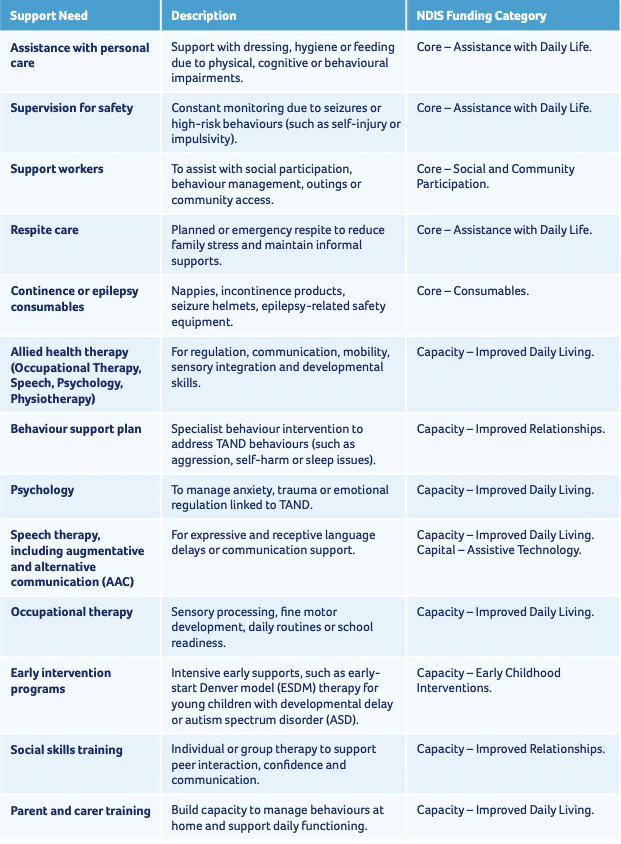
1. Core supports
• Assistance with daily living: This may include personal care, meal preparation or assistance at home. For those with high support needs, respite for carers should be considered. For children, this may additionally include aides at kindergarten or school.
• Support workers to help build social skills, access the community or assist with behavioural needs.
• Consumables, such as continence aids or epilepsy-related medical supplies.
2. Capacity building supports
• To address developmental delays, communication challenges or emotional regulation, evidence based therapies, such as occupational therapy, speech pathology, psychology, physiotherapy or behavioural support may be needed.
• Children with substantial developmental delays may need access to intensive early intervention programs, such as the Early Start Denver Model (ESDM).
• Support coordination to help manage complex needs and connect with appropriate services. • Skill development to assist with daily living, relationships and building independence.
3. Capital supports
• Assistive technology, such as seizure monitors, communication devices, sensory tools, prompting systems for cognitive support or mobility aids.
• Home modifications if mobility or safety is an issue due to seizures, behaviours (such as impulsivity or risk of absconding) or physical impairments.
4. Other considerations
• Respite care to provide family members or carers with a break and reduce carer stress and psychological harm.
• Specialist disability accommodation or supported independent living (SIL) if the person living with TSC has high support needs and requires ongoing assistance in a residential setting.
It is important to note that children with TSC and TAND can need significant educational supports. These may include:
Learning supports
• Educational aides to assist with focus, transitions and task completion.
• Specialist tutoring (NDIS may fund therapy-based supports outside of the school curriculum).
• Visual supports or assistive technology for learning and communication.
Behavioural and emotional supports
• Behaviour support plans developed by a psychologist or behaviour therapist.
• Social skills groups or 1:1 therapy to help with peer interactions and confidence.
• Psychological support for anxiety, regulation, or trauma-related challenges.
Therapeutic supports in school settings
These are usually delivered outside school hours but coordinated with the school:
• Occupational therapy: Focus on sensory processing, fine motor skills or classroom access.
• Speech therapy: For expressive/receptive communication or augmentative communication systems.
This guide has been developed by TSA (Tuberous Sclerosis Australia). We are indebted to the valuable input provided by members of our TSC Community and TSC health care professionals. TSA exists to support people affected by TSC.
We value your feedback, and you can contact us by:
Email: [email protected]
Post: TSA, 18 Central Road, Beverly Hills, NSW 2209
Phone: 1300 733 435 (Australia only)
You will find a wealth of information about TSC on our website tsa.org.au
TSA would also like to extend its sincere thanks to Sanofi for providing financial support to make the development of this resource possible. In accordance with its Policy, TSA can assure readers that Sanofi has had no input into, or control over, the content of this resource.

© Tuberous Sclerosis Australia 2026