
Navigating the NDIS: A guide for people living with TSC (Tuberous Sclerosis Complex)
This free guide is designed to help people living with TSC, and those supporting them, navigate the NDIS and prepare for NDIS planning meetings. You can access it online below or you can view and download a PDF copy by clicking here.
TSA has also prepared a support document that may be attached to an NDIS application or shared at a planning meeting. It can be downloaded and emailed to you by filling in the form at the bottom of this page.
Navigating the NDIS: A guide for people living with TSC (Tuberous Sclerosis Complex)
The National Disability Insurance Scheme (NDIS) is Australia’s national support system for people with permanent and significant disabilities. It provides individualised funding to help people achieve their goals, increase their independence and participate more fully in daily life. The NDIS is designed to give participants choice and control over the supports and services they receive.
For individuals and families living with TSC (Tuberous Sclerosis Complex) the NDIS can offer crucial support. However, navigating the system can be complicated. Outcomes can vary depending on factors like who your planner is, where you live and how well your needs are presented. People can find the process confusing, inconsistent, and/or overwhelming.
This guide will be revised as necessary to reflect any changes resulting from the ongoing NDIS review (Oct 2025).
This guide is designed to help people living with TSC, and those supporting them, navigate the NDIS and prepare for NDIS planning meetings. You can also find general information regarding TSC and the NDIS on TSA’s (Tuberous Sclerosis Australia’s) website.
This guide is designed to help people living with TSC, and those supporting them, navigate the NDIS and prepare for NDIS planning meetings. You can also find general information regarding TSC and the NDIS on TSA’s (Tuberous Sclerosis Australia’s) website.
In this guide, we cover:
• How to get the most out of your NDIS planning meeting
• What medical reports and assessments to take to the meeting to clearly demonstrate the functional impacts of TSC
• How to write a carer/impact statement that captures the full picture of care needs
• Goal setting
• Review meetings
• Helpful supports and services.
NOTE: Where we say ‘you/your’ in this resource, this generally refers to the person living with TSC and may be the person you care for rather than yourself. We may also use ‘participant’ to differentiate between the person living with TSC and the person caring for them.
A key step in the NDIS journey is the planning meeting. This is the meeting where your needs, goals and daily challenges are discussed and where the types and amount of support you may receive are decided. Planning meetings occur when you first join the NDIS, when your current plan is due to be reviewed and when your circumstances have changed. These meetings can be in person, over the phone or online, and they are your opportunity to make sure that your support needs, or those of the person you care for, are clearly understood and reflected in the plan.
How can you get the most out of your NDIS planning meeting?
Preparation is key to getting the most out of your NDIS planning meeting. Here are some things to consider when preparing for your meeting:
Functional capacity, not just diagnosis, informs the funding. That’s what planners need to see.
• Prepare ahead of time
Read through TSC and NDIS resources. Consider supports for health, communication, learning, behaviour, independence and community participation.
• Understand and explain the complexity of TSC of time
TSC affects many areas of life – neurological, behavioural, physical and cognitive. A person living with TSC may have epilepsy, intellectual disability, autism, anxiety, sensory issues or other invisible symptoms. Explain how these challenges affect your everyday life, routines, safety and wellbeing.
TIP: TSA has prepared a document explaining TSC and its lifelong impacts, which can be attached to your NDIS application or shared at your planning meeting. This letter outlines how TSC affects functional capacity, common challenges, including TSC Associated Neuropsychiatric Disorders (TAND) and the kinds of supports typically needed. Having this document on hand can help planners better understand the condition and why ongoing, multidisciplinary support is essential.
• Consider who will attend the meeting
Consider taking a support person, such as a family member, advocate or therapist, who can help communicate your needs at the meeting. If you don’t have someone available, ask your local area coordinator (LAC) about having an advocate present.
• TAND and the impacts on your daily life
TAND is often misunderstood. Help your planner understand the behavioural, emotional and cognitive challenges you face. This may include sleep issues, aggression, anxiety, autism traits, attention difficulties or intellectual disability. You can find information about TAND on TSA’s website, and the TAND checklist can help explain your experiences.
• Collate all relevant documentation and take it to the meeting
Include medical reports (neurologist, cardiologist, geneticist or paediatrician), therapy assessments (occupational therapist, speech therapist or psychologist), education plans, behaviour support plans and a functional assessment. These help provide evidence of the impact of your disability and justify the supports you are requesting.
• Take your banking and MyGov details
These may be needed to link your plan or make service bookings.
• Tell your story in detail
Describe a typical day, including:
> How seizures, fatigue or sensory issues affect your routine
> How you manage medication, hygiene, meals, communication, appointments and social interactions
> What support you need to stay safe and function at home or in the community > What you would like to do more independently, and what’s currently holding you back > The emotional toll of managing a lifelong, complex condition.
TIP: Don’t be afraid to speak openly. Many people living with TSC and their families feel they must ’hold it all together”, but this is the time to talk honestly about your struggles, support gaps and goals.
• Highlight family and carer needs
Carers often experience high stress due to medical complexity, behaviour support needs and lack of respite. Include the carer’s perspective and ask for support, such as respite, carer training and in-home help.
• Ask questions
If something doesn’t make sense or seems unfair, ask for clarification. If a support is denied, ask: “How can we make this work?” It’s okay to challenge decisions respectfully and ask for evidence or appeal options.
It’s not enough to list symptoms- (planners) need to understand how those symptoms limit daily life.
Medical reports and assessments to bring to your NDIS planning meeting
Providing comprehensive documentation can help ensure the NDIS planner fully understands the impact of TSC on your daily life as well as your long-term needs. It is helpful if reports clearly identify support requirements and include consistent recommendations on what is needed to assist you, or the person you care for, to participate fully in social, learning and everyday life activities.
You can find a checklist of the recommended medical reports and assessments in Appendix 1.
Carer/impact statements for NDIS applications
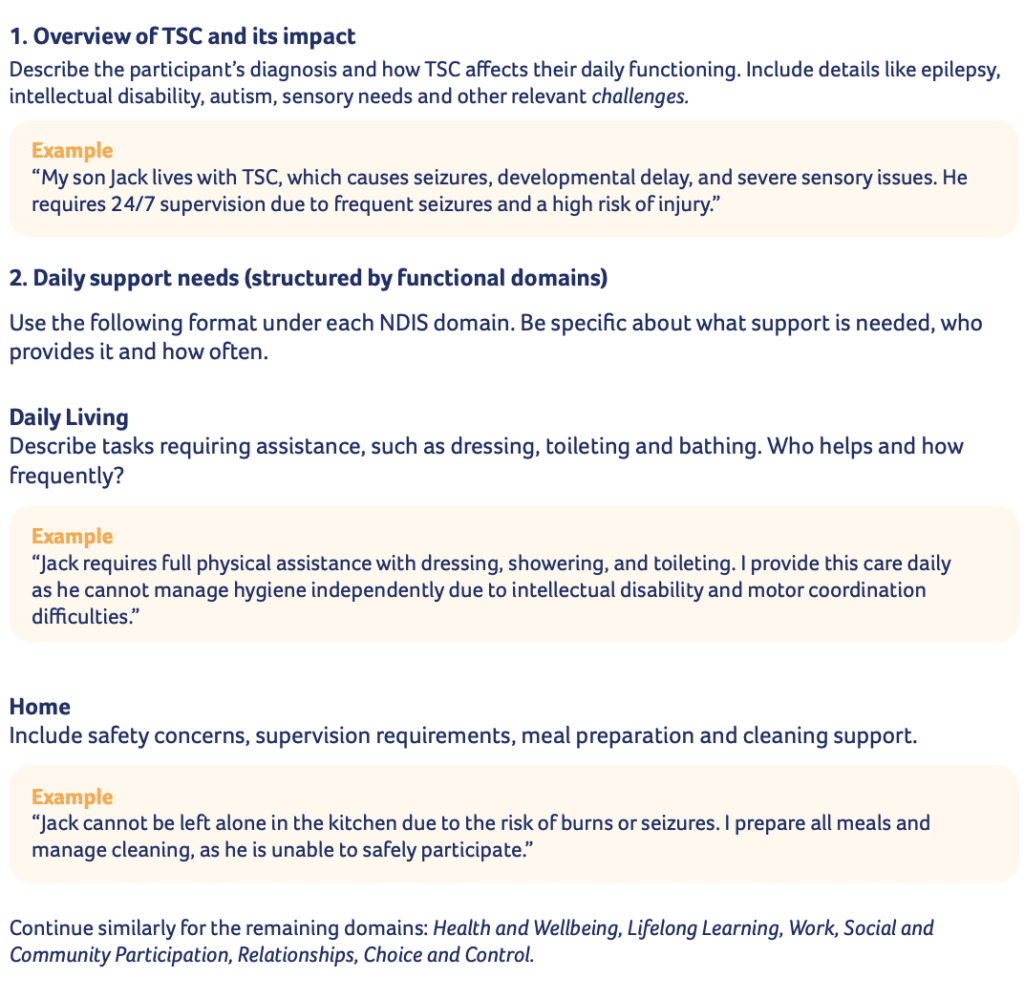
When applying for NDIS support for someone living with TSC, a carer or impact statement can be a valuable addition to your application. Written by the person who provides day-to-day care, this statement helps the NDIS understand the real-life impact of TSC, not just on the individual living with TSC, but also on their carer and family.
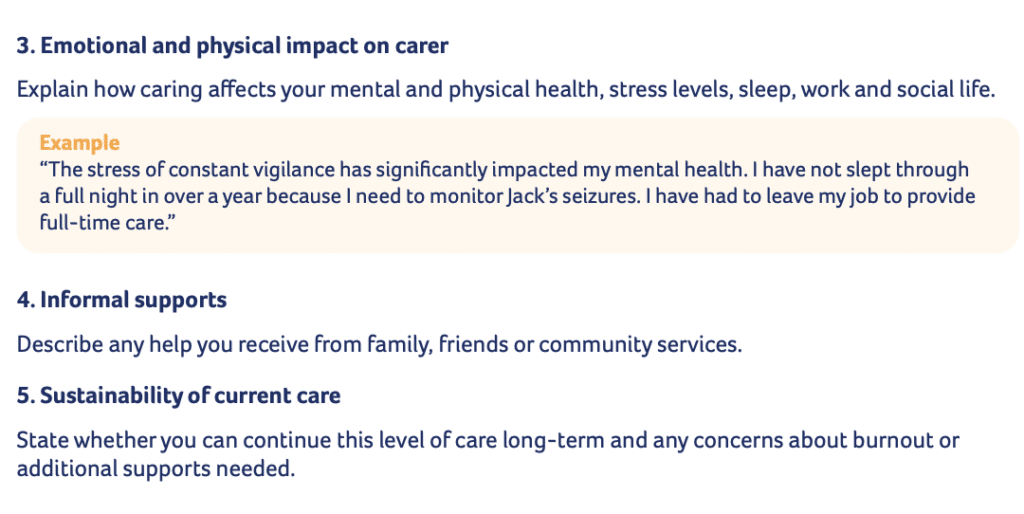
While not a mandatory requirement, it is a chance to explain the challenges faced, the level of support provided and how caring responsibilities affect your own wellbeing as a carer. A clear and honest statement can help ensure that the NDIS planner sees the full picture and considers the appropriate supports. You can find tips and examples of what to include in your carer’s impact statement in Appendix 4: Carer’s statement documentation tips
TIP: Be honest. Describe what a bad day looks and feels like. The NDIS needs to understand the full impact of TSC on your life to allocate appropriate supports.
You may wish to use NDIS’ 6 major functional capacity areas to guide you when writing your statement:
I outlined her needs from the moment she woke up to the time she went to sleep. It showed the level of care required every day.
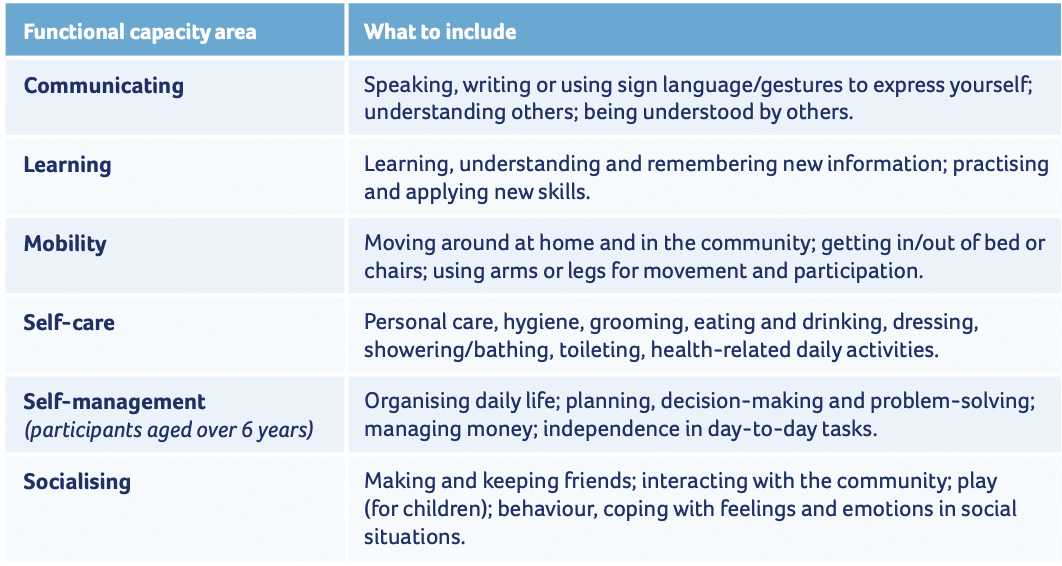
You can use these categories to describe:
• What support is needed
• How often support is required
• The emotional and practical impact of having this support/not having this support
• Any costs involved in providing this support.
How to write a carer/impact statement for TSC
There is no prescribed format for a carer/impact statement. It can be a simple letter or a structured response. Either way, for each affected life area (‘functional domain’), describe in simple terms:
• What the person cannot do without support due to their impairment (give clear, real-life examples).
• How this impacts their day-to-day life, school, work or relationships with peers and the community.
• What supports are already being provided (by family, carers, services or the community) and how effective they have been.
• What additional supports are needed (including frequency/intensity) and how these would build skills, maintain capacity or slow the progression of difficulties.
• How these supports will improve participation in social and community life and, where relevant, education or employment.
It is important to focus on the impairment and its impact, not just the medical condition. For example, instead of saying, “She has epilepsy due to TSC,” explain how it affects daily functioning. For example, “Frequent seizures mean she cannot safely shower alone, and needs constant supervision when outside the home.”
TIP: Outline the person’s daily support needs from when they wake up until they go to sleep. This should describe what supports are required, when they are needed and who is currently providing them. Framing this information around the participant’s functional needs, rather than the carer’s workload, supports a stronger case for reasonable and necessary funded supports under the NDIS.
When carers talk about needing help, it can be misunderstood. The focus must stay on the participant’s support needs.
Who can provide a carer/impact statement?
While a parent or primary carer usually writes the statement, anyone who provides regular support, such as a relative, teacher or service provider, can also write a carer statement. Their perspective can further show the full scope of support needed.
For examples of supports and services tailored to common challenges in TSC, see Appendix 3.
Goal setting for NDIS planning meetings
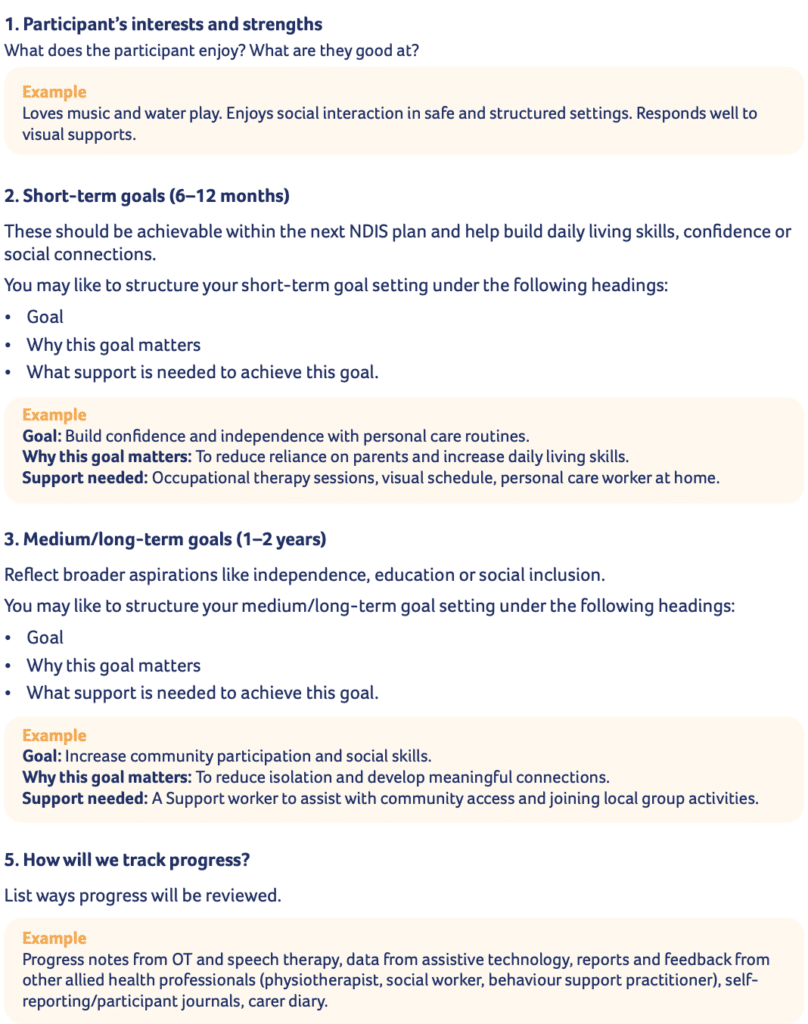
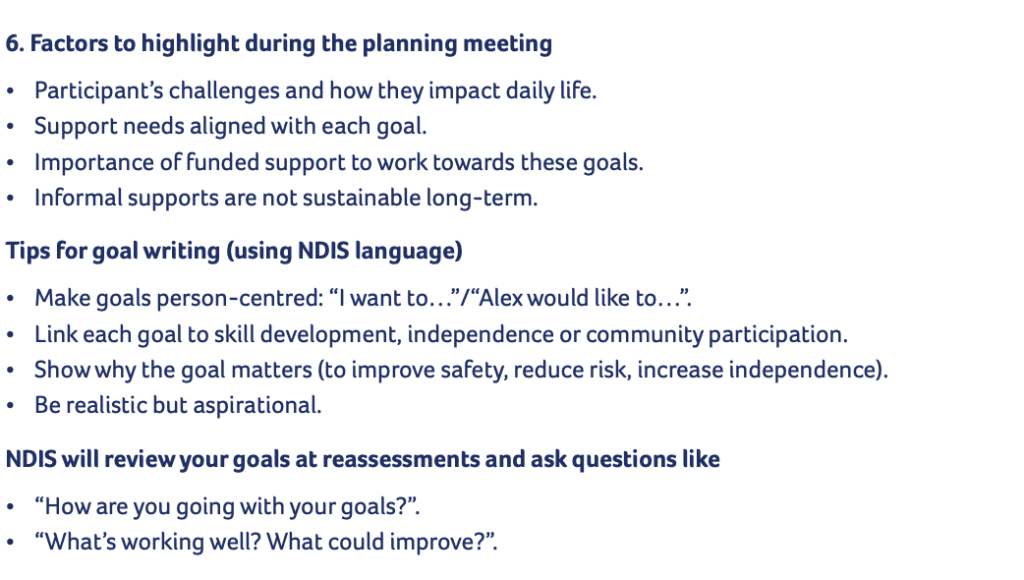
Setting clear and meaningful goals is a key part of your NDIS plan. Goals guide the supports and services you receive, helping you work towards greater independence, participation and quality of life. Well-defined goals make it easier to measure progress and adjust your plan as needed.
Make sure you are clear about the goals you have and that the evidence you have supports the goals. That’s really important.
Why goal setting matters
• Focuses your plan: Goals ensure your supports are tailored to what matters most to you.
• Guides funding: Supports must be linked to achieving your goals to be approved as reasonable and necessary.
• Measures progress: Clear goals help track what’s working and where adjustments may be needed.
Tips for setting effective goals
• Be specific and clear: For example, instead of “improve social skills,” say “attend weekly community group and initiate conversation with at least one new person each session.”
• Make goals measurable: Use specific, trackable outcomes such as, “increase participation in community activities from once a month to twice a week over six months.”
• Focus on what’s important to you: Choose goals that reflect your priorities, interests and needs.
• Set achievable steps: Break larger goals into smaller, manageable steps to build confidence and momentum.
• Include short and long-term goals: Short-term goals can be achieved in the near and medium term future; long-term goals focus on bigger changes.
• Link goals to supports: Make sure the supports you request clearly help you work towards your goals.
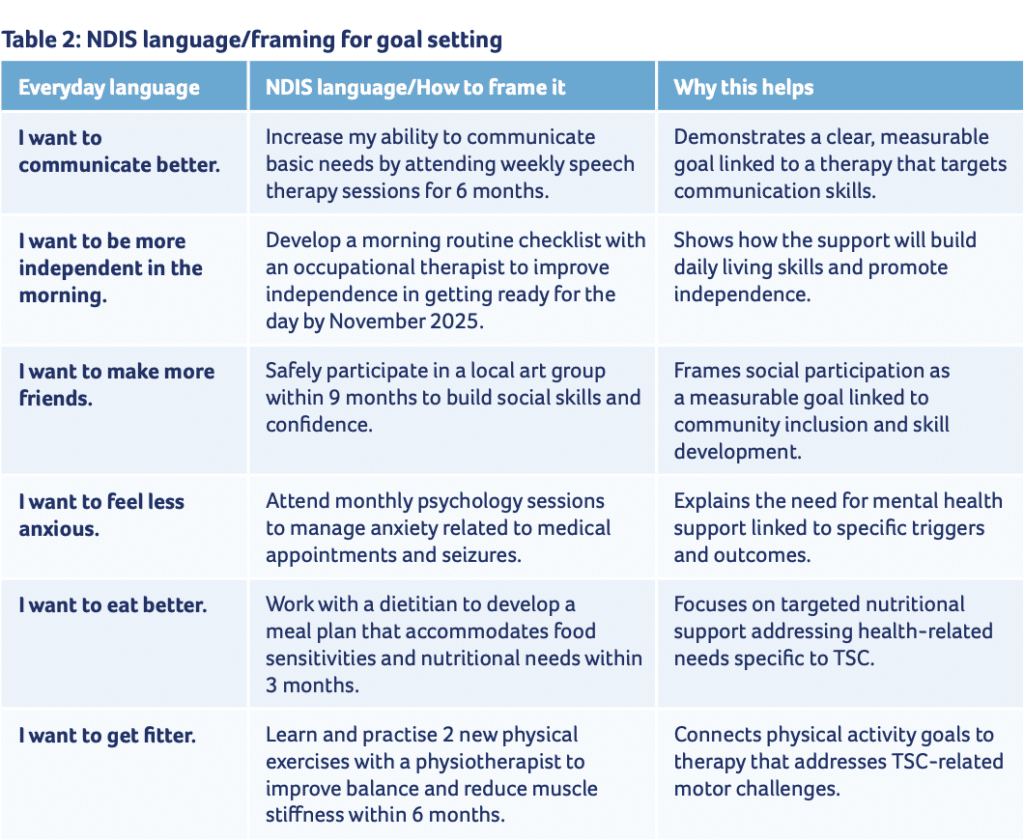
You can find more goal-setting tips, including examples, in Appendix 5.
The NDIS plan review meeting is an opportunity to assess how well your current supports are meeting your needs and to plan for the upcoming year. It allows you to update your goals, request necessary changes, and ensure your funding aligns with your evolving circumstances. Preparing thoroughly for this meeting helps you advocate effectively and get the most out of your NDIS plan.
Every review feels like they expect she’s suddenly better. We have to constantly reiterate that this is a permanent, significant disability.
Getting the most out of your NDIS plan review meeting
• Request a face-to-face meeting before your current plan ends. This allows for better communication and ensures your needs are fully understood. If possible, avoid having the review over the phone.
• Clarify what’s required by your Local Area Coordinator (LAC) or planner before the meeting. Be prepared with all relevant documents, reports and evidence to support your goals and funding needs.
• Gather assessment reports and quotes from your providers and therapists ahead of time. Having up-to-date professional recommendations strengthens your case for supports in the new plan.
• Review your current plan in detail – note what supports worked well and what didn’t and consider any changes in your needs or goals since your last plan.
• Set clear, achievable goals for the next plan period. Think about both short-term and long-term goals, and how the supports requested will help you achieve them.
• Bring a support person or advocate if you want extra help during the meeting to ensure your voice is heard and your needs are communicated clearly.
• Be honest and specific about your support needs and challenges. Concrete examples of daily tasks or situations where support is needed can be very helpful.
• Discuss informal supports and how they fit into your plan. This helps show the full picture of your support network.
• Ask questions if you don’t understand parts of the plan or the process – your planner is there to help you.
• Keep records of everything discussed and any agreements made during the meeting for future reference.
NDIS decision review process
If you disagree with a decision made by the NDIS, you can request an internal review. This process allows a different NDIA (National Disability Insurance Agency) officer to assess the original decision. You must submit your review request within 3 months of receiving the decision in writing. If you’re still dissatisfied after the internal review, you may seek an external review by the Administrative Appeals Tribunal. Find more information about this process on the NDIS website.
Association for Children with a Disability (ACD)
Provide NDIS information and advocacy to support families of children with disabilities. Victoria based but they operate a national help line.
Here are some links to useful guides on the NDIS website
• A guide on how NDIS supports work
• How the planning process works
• NDIS booklets and factsheets
• Requesting a review of a decision
• Setting short and long-term goals
A tool designed for individuals and families living with TSC to identify and understand TSC Associated Neuropsychiatric Disorders. The Checklist can be used to screen, quantify and guide support and healthcare discussions.
The TAND Toolkit was created by the international TAND Consortium together with families and professionals from around the world. It is designed to help people living with TSC and their families better understand and manage TAND. The toolkit is organised around 7 natural TAND clusters, plus an eighth wraparound cluster about wellbeing and family relationships.
Parents can apply for small grants through the foundation to help children under 12 access essential therapies when NDIS funding runs out. If the application is successful, the foundation pays the therapy bill directly.
TSA operates a telehealth nurse service staffed by a Registered Nurse to provide information and support to people living with TSC or a possible diagnosis of TSC and their families and carers. The service also assists clinicians caring for people with TSC. Health care professionals can contact the nurse for TSC-specific advice and recommendations on clinicians and specialists experienced with TSC across Australia. You can book a call with the TSA nurse, call 1300 733 435 (Australia only) or email [email protected].
TSA is the only charity in Australia supporting people living with TSC. By providing knowledge, support and connections, we aim to create a better life and a more hopeful future for everyone in Australia affected by TSC. TSA supports individuals and families affected by TSC, fostering a community for shared experiences and learning. We connect people to expert health care professionals and services. Collaborating with our Medical Advisory Panel and global researchers, we seek new treatments, screening options, and ultimately, a cure for TSC.
We raise awareness, advocate for better health care access and partner with TSC International, Rare Voices Australia and Tuberous Sclerosis Complex New Zealand. TSA is the trusted go-to resource for information, advice and support for everyone in Australia affected by TSC.
Visit TSA’s website for up-to-date information on TSC, including resources for people living with TSC and families and caregivers, materials for health care professionals and details on TSC signs, symptoms and treatments.
Appendix 1: Medical reports and assessments checklist
Having the right medical reports and assessments at your NDIS planning meeting can help clearly demonstrate the impact of your disability and the supports you need. These documents provide objective evidence for your requests and ensure the planner has accurate, up-to-date information to base decisions on. The following checklist will help you gather the most relevant reports and assessments so you can attend your meeting well-prepared.
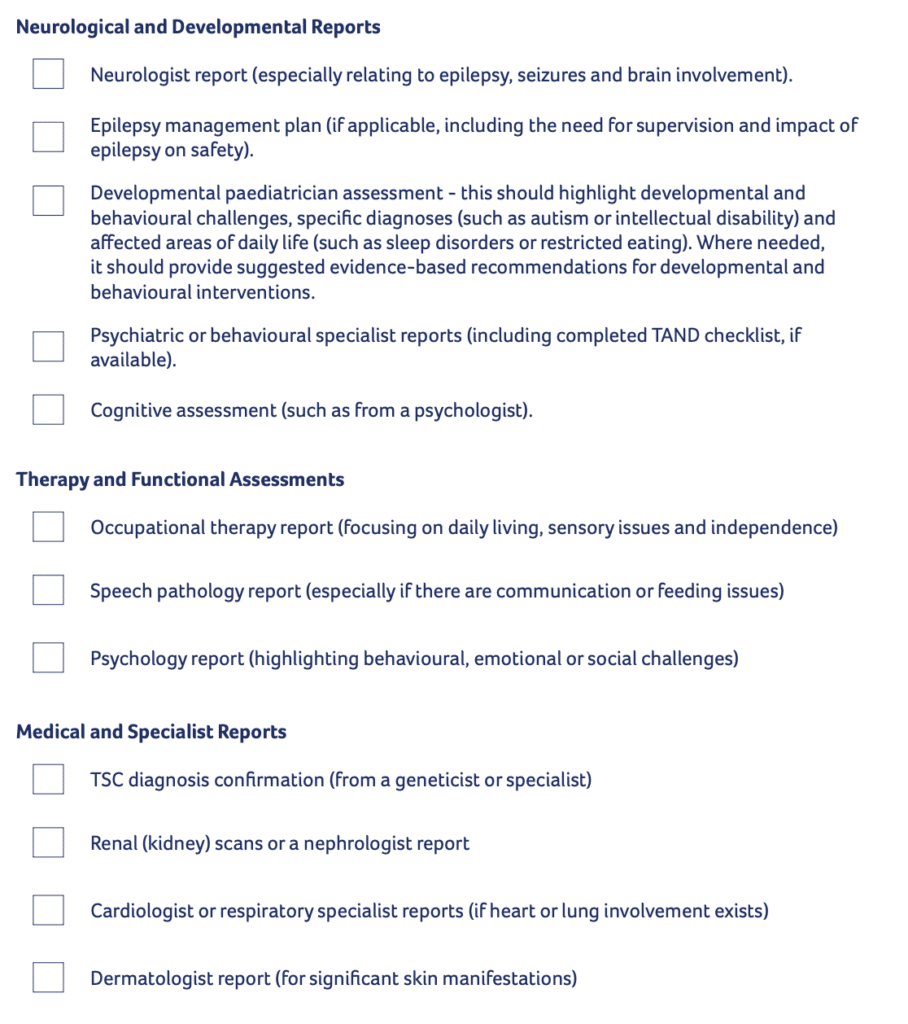
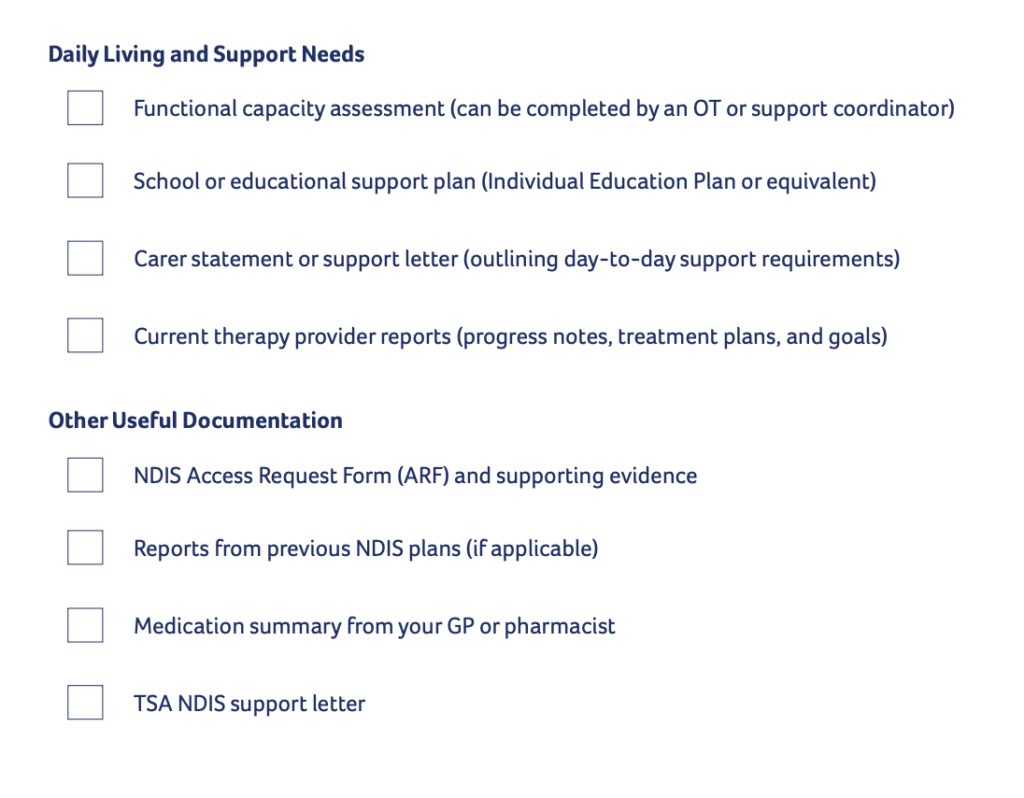
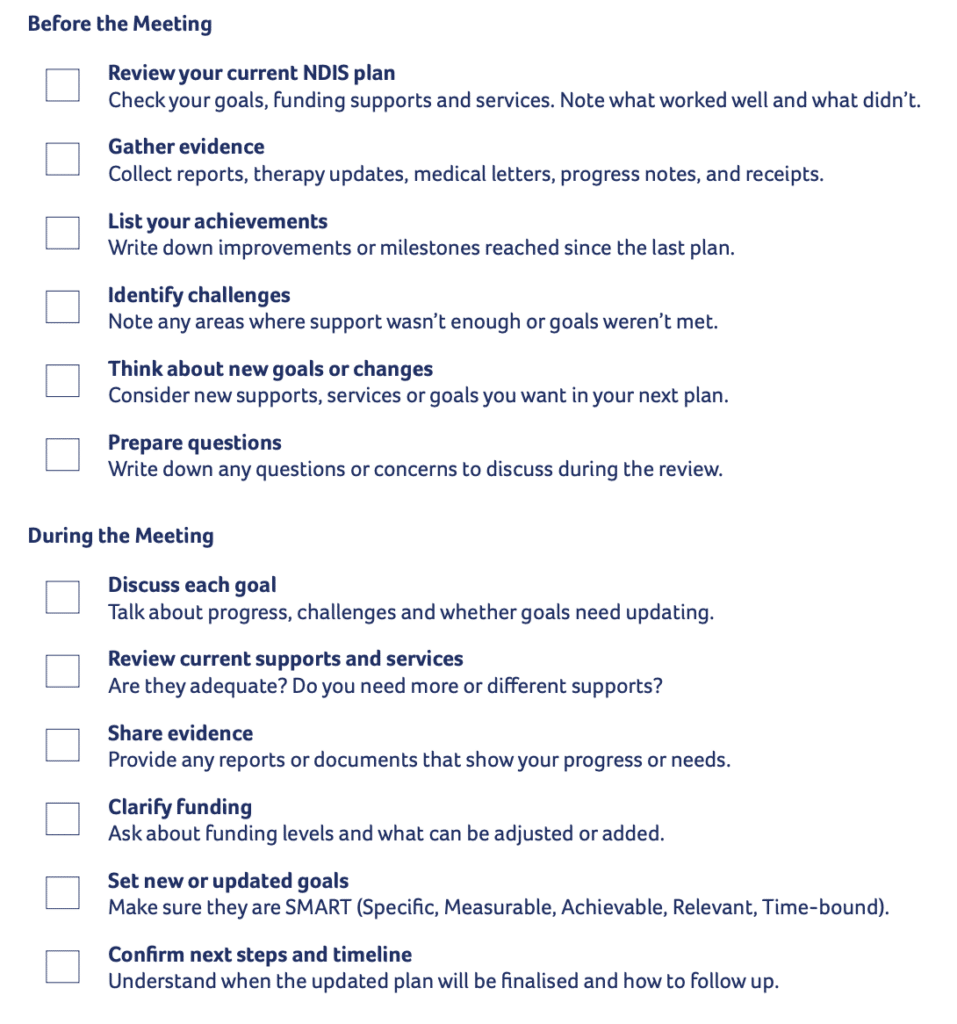
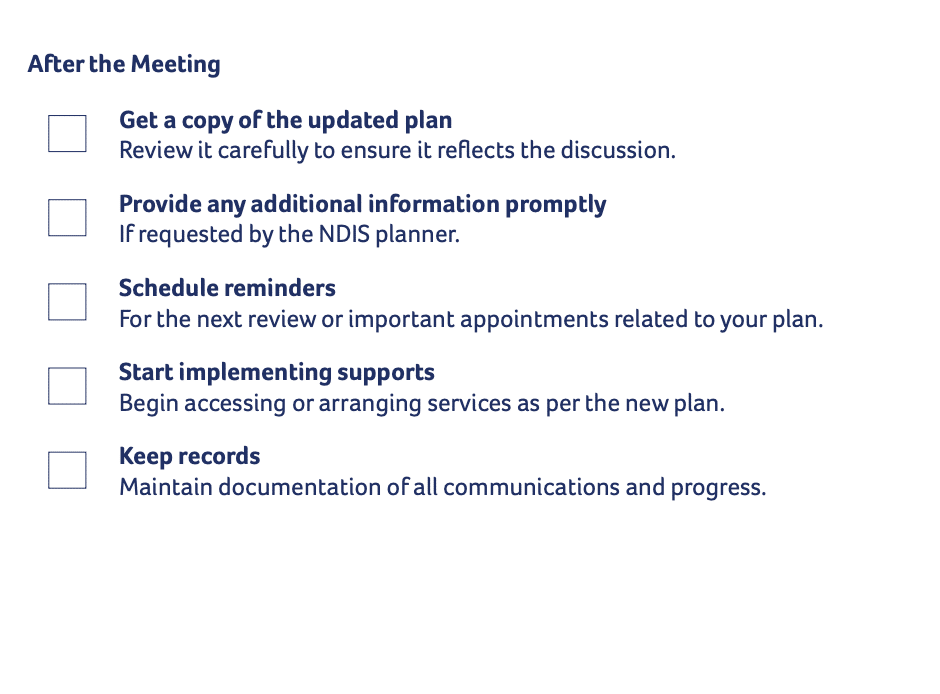
Appendix 2: NDIS review meeting checklist
Preparing for your NDIS review meeting is an important step to ensure your plan continues to meet your needs and goals. This checklist will help you get organised, track your progress and communicate effectively with your planner or support coordinator. By reviewing what’s worked well, identifying challenges and setting clear goals, you can make the most of your review meeting and ensure your supports are tailored to your specific needs.
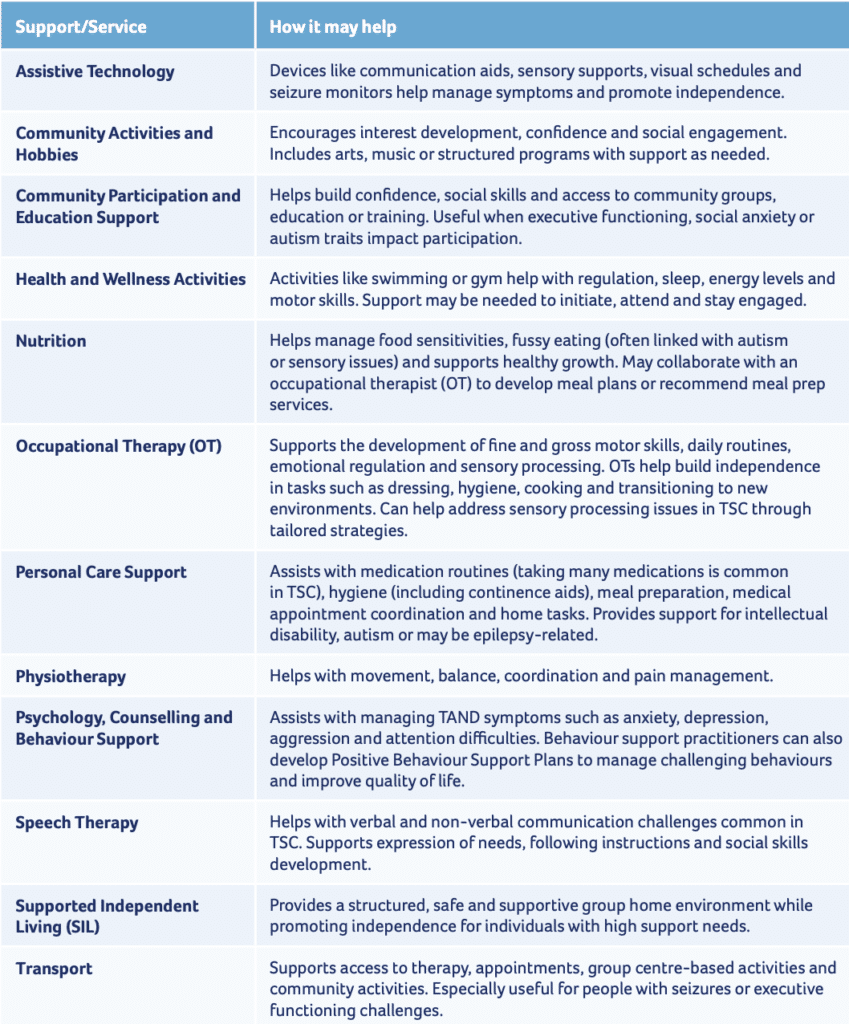
Appendix 3: Helpful supports and services for people living with TSC
The supports and services below are tailored to common challenges associated with TSC, such as epilepsy, developmental delay, autism traits and TAND. Please note that not all services listed may be funded by the NDIS. However, including any that are required for participating in daily life in your planning discussion can help ensure your needs are fully considered.
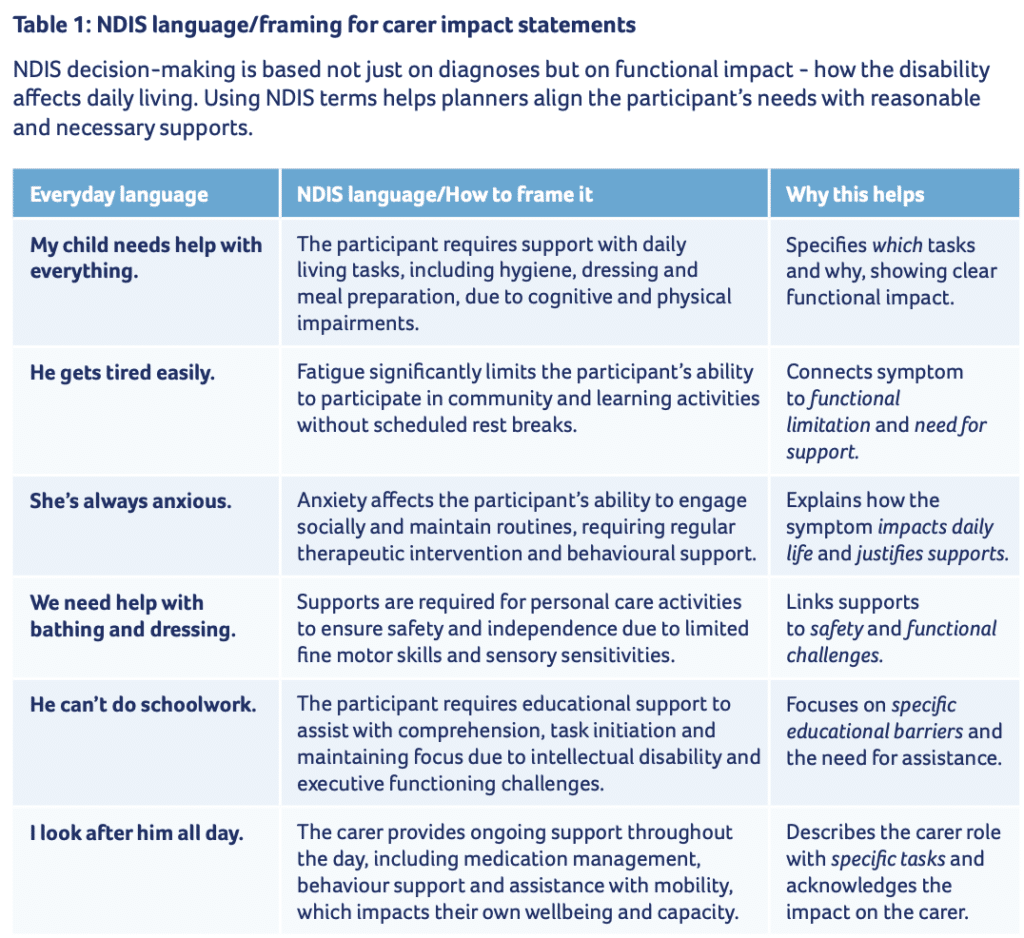
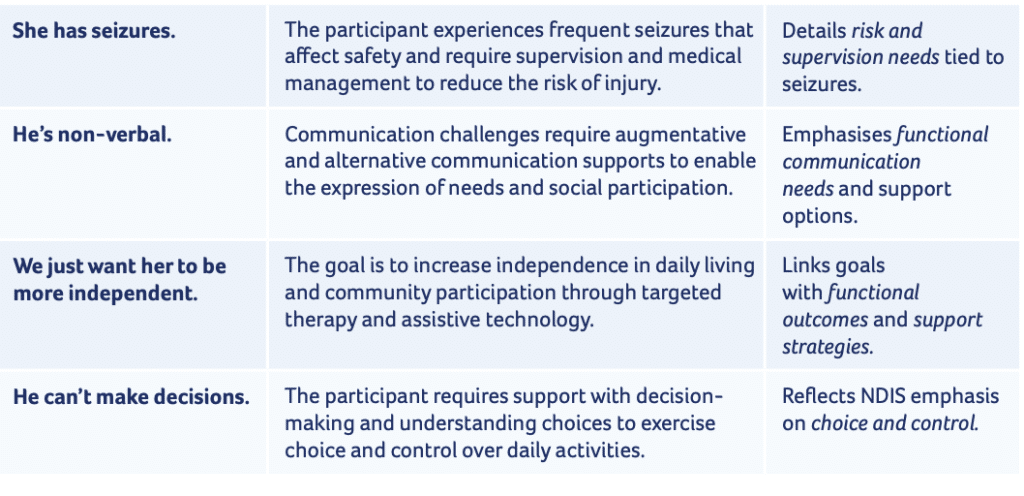
A carer’s statement is your opportunity to explain the level and type of support you provide as a carer to the person you care for, and the impact this role has on your own life. The NDIS uses this information to understand the participant’s daily support needs and the extent of informal care provided. The way these needs are described can make a big difference to how they are understood. The following examples show language that can clearly and accurately convey support requirements in a carer impact statement. Frame everything around the participant’s functional capacity. For example, instead of saying, “I need help because I’m exhausted.” Say: “The participant requires daily assistance with all personal care, and current informal supports are unsustainable.”
Remember, setting a goal doesn’t guarantee funding for a specific support; instead, NDIS will consider supports that help you overcome disability-related barriers to pursue your goal.
Acknowledgements
This resource was originally prepared by Katrina Watt RN, TSA Nurse in October 2025.
TSA is indebted to the following clinicians, health care professionals and families living with TSC for their input and advice:
• Sharon Balsarini, NDIS Navigation and Liaison Officer
• Dawn Bowra
• Les Cope
• Debbie Crosby, former president of TSA
• Dr Beck Mitchell, Developmental Paediatrician.
Thanks also to Teresa Llewellyn- Evans for editorial support.
We value your feedback, and you can contact us by:
Email: [email protected]
Post: TSA, 18 Central Road, Beverly Hills, NSW 2209
Phone: 1300 733 435 (Australia only)
You will find a wealth of information about TSC on our website tsa.org.au
TSA would also like to extend its sincere thanks to Sanofi for providing financial support to make the development of this resource possible. In accordance with its Policy, TSA can assure readers that Sanofi has had no input into, or control over, the content of this resource.


© Tuberous Sclerosis Australia 2026
Download NDIS Support Document
TSA has prepared a support document that explains TSC, its lifelong impacts, how TSC can affect functional capacity and the types of supports that are typically required. This document may be attached to an NDIS application or shared at a planning meeting to support planners’ understanding of TSC and the need for ongoing, multidisciplinary support. You can download and be emailed a copy of this document by filling in the form.